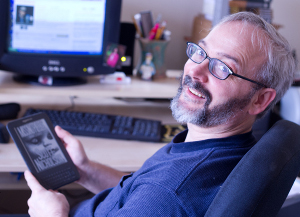
 Scott Nicholson, a best-selling indie author, has written more than twenty novels, about eighty short stories, comic series, children’s books, screenplays and a couple of non-fiction books. Prolific is an understatement when describing this successful author of horror, mystery and suspense thrillers.
Living in the Appalachian Mountains of North Carolina, Nicholson tends an organic garden, successfully eludes stalkers, and lives the dream, creating at a furious pace and winning awards for his work.
His latest release, The Home, takes place in a group home for troubled children. Experiments lead to paranormal activity and ghosts appear from the home’s dark past as an insane asylum. The Home is currently being developed as a feature film.
So without further adieu, it is my great pleasure to introduce my guest, the one and only Scott Nicholson.
Blackwell: Let’s start with The Home. Maybe you could talk a little about the setting for the movie version of this novel, as well as the cast and director? And when will it be released?
Nicholson: Well, that’s still a long way away. It has been optioned and a script is circulating, but it takes a little luck at this point. Even in the best of circumstances, it would probably take a couple of years before it hit the screen or DVD, and, of course, I’d have zero influence on the finished product.
Blackwell: Your writing has often been compared to Stephen King, the master of summoning serious scares. In your view, what author or authors does your work most closely emulate or compare to?
Nicholson: King comparisons are always flattering, although kind of hilarious for us mere mortals. I’ve also had Dean Koontz and Bentley Little comparisons, and I will gratefully accept those because both are fine wordcrafters.
Blackwell: Who is your favorite author? And why?
Nicholson: This varies, but my top tier is Mark Twain, Stephen King, William Goldman, Ira Levin, Shirley Jackson, and James Lee Burke. Writers who can tell a good story while maintaining high literary value carry the most weight with me. The work of Dr. Seuss is probably the highest literary achievement of the English language.
Blackwell: That brings me to my next question: a question of genre. It seems there is so much overlap with genre these days, a writer in one book can cross over into multiple genres. I’ve heard you called a mystery, horror, paranormal, suspense and thriller writer. If you had to decide on a genre that most clearly represents the mosaic of work you’ve created, what would that genre be?
Nicholson: I usually call myself a “thriller writer,” because that is broad enough to cover many potential audiences without losing readers to some misperception or prejudice of genre. After all, few people call themselves “horror readers,” yet millions still pick up Stephen King books. Genre was useful to bookstore owners but it is increasingly less relevant today, when we can search the Internet for books in myriad ways.
Blackwell: Okay, let’s talk a little bit about the writing process. How many words a day do you average when you’re writing a book? And, is there a particular time of day or night that you find you’re at your best? Please answer in relation to The Home, so I can try and find a consistent theme to this interview, if that’s even possible.
Nicholson: Well, I wrote The Home about 10 years ago and it was published in paperback in 2005. I got the rights back and revised it a good bit, using what I had learned in the meantime. Because I am a publisher among other things, I don’t “just write.” A good day can yield a couple thousand words but I am generally happy if I can average 500 words a day, seven days a week.
Blackwell: Is there anything in particular that you do while you write, like listen to music, to inspire you?
Nicholson: I occasionally listen to music, but only albums I am already familiar with so I don’t have to spend mental energy listening. But I am happy with silence, too. I chose my lifestyle and worked to make it happen, and now here I am: a hillbilly hiding away in the holler, wearing grungy sweat pants.
Blackwell: I’m the same. I often write in paint-stained sweat pants. Some of the horror scenes are quite frightening in your work. Do you have to work yourself into a certain mindset to be able to create this kind of raw terror?
Nicholson: No, I really just trust the characters and the story to pull me into its web. There’s something magical and beyond the writer’s conscious ability when the story takes off of its own accord, and that shamanistic journey is far better trusted than a writer’s egotistical manipulation of fictional events.

Blackwell: Your writing style is very concise, yet evocative. Did it take you a long time to find your muse?
Nicholson: I don’t know about Muses. It’s complicated. While there is some magic involved in writing, the magic already exists and just needs to be tapped. It’s not some distant force or entity that chooses to visit once in a great while. It is something that shows up when you surrender to the work. Of course, logging fifteen years at the keyboard makes it seem a little easier.
Blackwell: When did you know you wanted to become a writer full-time? And, once you decided, how long did it take you to become successful?
Nicholson: Well, I always knew I’d be creating things all my life, but I never thought about “career,” “job,” or “money.” I was in rock bands for a decade, and I’ve been an artist, and I’ve always been fabricating stuff. Even as a musician, I never wanted to learn Rolling Stones tunes and grind them out for a bar crowd, I wanted to invent new sounds and words and rhythms. But in 1996, when I got a college degree, I became terribly afraid I was becoming a real person, so I instantly set about to become a professional writer. Beats the heck out of growing up.
Blackwell: You got that right. I tried the growing up part. It didn’t work so well. Let’s talk about your next book. When will it be released and what’s it all about?
Nicholson: I am releasing AFTER shortly before Christmas, the first entry in a post-apocalyptic trilogy. It’s got some standard elements of the subgenre but a scientific spin I’ve not seen before. I am mostly done with the first draft but I have to make sure it stands alone as well as bridges to the later books.
Blackwell: Do you have any goals in terms of how many novels you would like to crank out per year?
Nicholson: Yeah, “crank” is the word we use for it now, since there are no artificial deadlines imposed by the publishing process. But I am happy to put out a couple of books a year. Especially these days, when the backlist is always available, you can keep meeting new readers around the world every single day, so there’s no real need to rush. Quality will last.
Blackwell: How would you summarize what you are trying to achieve in all your work? In other words, what can a reader expect from a Scott Nicholson novel?
Nicholson: I’ve only recently been able to articulate this, but I don’t care all that much about shocking, scaring, thrilling, or even necessarily entertaining people. Primarily, I want to move them emotionally, to have them in a different place when they finish the story. That’s part of the spiritual and magical aspect of the journey, and much of it happens on the subconscious level. I believe the reader does most of the legwork on that journey, and the experience of a book is unique to each person. But I also want the reader to enjoy the ride.
Blackwell: Tell me a little quirk about your personality and interests that might surprise your audience?
Nicholson: I am a serious organic gardener and heirloom seed saver. Some might find that weird, but it fits into my philosophy of compassionate self-reliance that I hope is reflected in my books.
Blackwell: Tell me five things on the bucket list you want to do before you die?
Nicholson: Watch my daughter graduate from college, watch her get married, watch her have a career, watch my wife settle on a fulfilling creative path, and to eat seven pounds of bacon in one sitting. I am assuming the bacon will coincide with the actual kicking of the bucket.
Blackwell: That’s hilarious Scott—more so since I just finished a Big Mac. Maybe my time’s coming. Still, slightly less grease in a Big Mac than seven pounds of bacon. Let me try and stay on topic, not easy for a meandering mind such as mine. What advice would you offer to other authors trying to break into the indie author game?
Nicholson: Educate yourself on all levels of art, craft, and business. It’s harder to sell a book than it is to write one. Good marketers are far rarer than good writers. And once you choose the lifestyle, make it a life, not a job. I look at the simple reality of my own path and see no special talent or genius. All I did was outlast the people who said “No.”
Blackwell: What book or books would you recommend to an upstart indie author?
Nicholson: Not to push my own book, but The Indie Journey projects some of my philosophical principals in approaching a writing career or hobby. There are many other books with better how-to tips, such as Let’s Get Digital. The problem with books on indie publishing is that everything changes every six weeks, so you have to immerse yourself in it at all levels and weave yourself into the fabric of the digital movement. However, the fundamentals never change—share a well-written tale.
Blackwell: That’s it for this author spotlight. If you’re looking for an entertaining and talented writer, I encourage you to check out Scott Nicholson’s work. Feel free to ask questions of Nicholson using the comments section below and, until next time, thanks for stopping by.
Connect with Scott Nicholson at his website: http://www.hauntedcomputer.com
Email: authorscottnicholson@gmail.com
Twitter: @eScottNicholson